

CALL FOR PAPERS
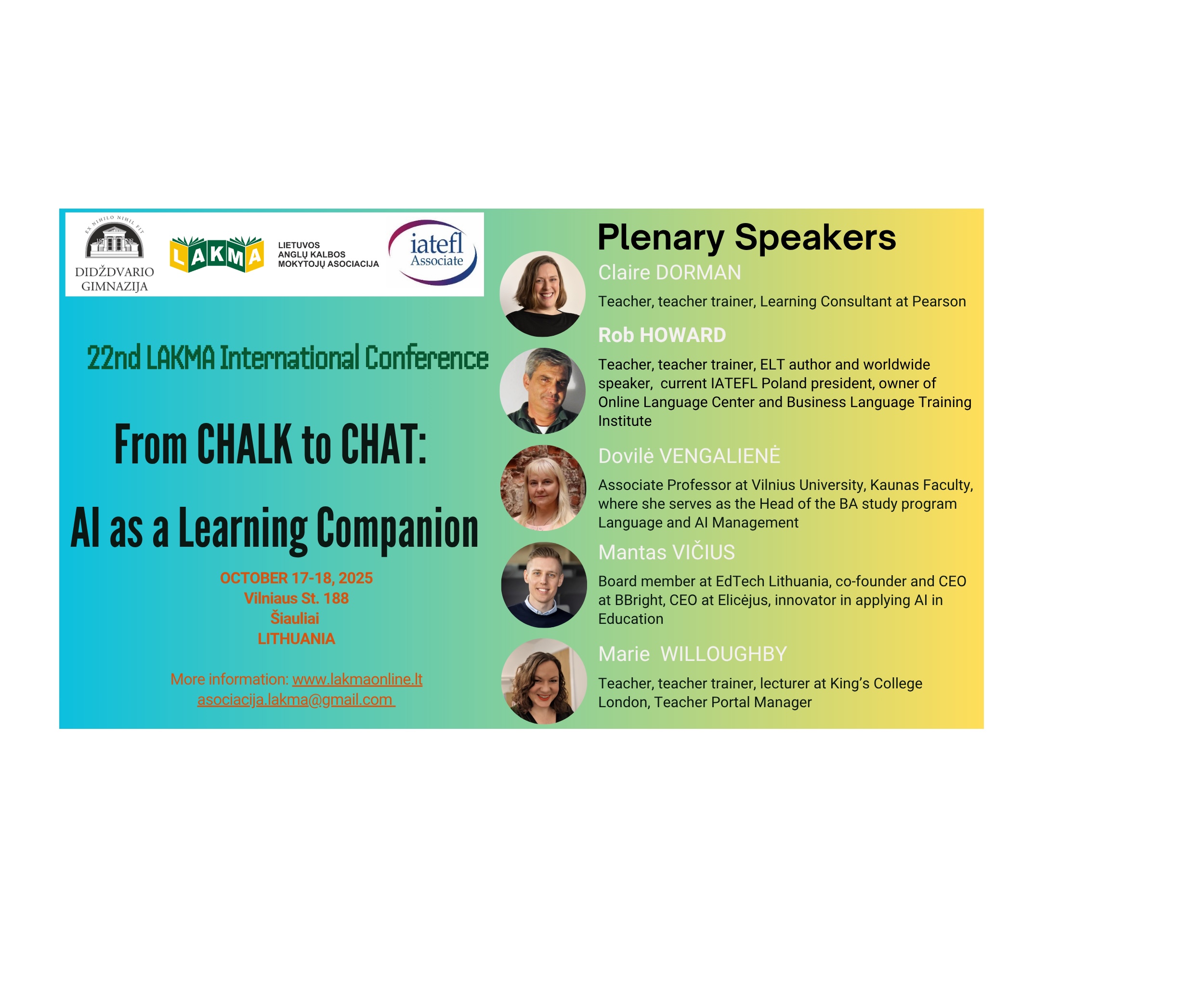
22nd LAKMA INTERNATIONAL CONFERENCE 2025
FROM CHALK TO CHAT: AI AS A LEARNING COMPANION
17–18 October 2025
Šiauliai Didždvaris Gymnasium
Vilniaus g. 188, Šiauliai, LITHUANIA

The conference aims to explore the transformative power of artificial intelligence in language learning and teaching. Building on our 2017 conference, “With and Without Technologies,” we return to a topic that continues to evolve and inspire. While technology has long played a vital role in education, the rapid development of AI has shifted the conversation. The question is no longer whether technology belongs in language learning, but how we can harness its potential to enrich teaching and empower our students.

We warmly invite English language educators, researchers, and technology experts to submit proposals on any aspect of utilising AI in teaching and learning English.

SESSION FORMAT

  • Workshops (60 minutes incl. questions)
  • Oral presentations (30 minutes incl. questions)

IMPORTANT DATES
September 15th – deadline for submitting speaker proposals
September 18th – notification of acceptance of papers
September 29th – deadline for speaker registration and payment
October 13th – deadline for non-speaker registration and payment

FEES

  • Speaker and non-speaker fees are the same.
  • Teacher Fee: 40 EUR for LAKMA members / 80 EUR for non-members
  • Student Fee: 5 EUR for LAKMA members / 10 EUR for non-members

BANK TRANSFER

Please transfer the fee before completing the online registration form.
LAKMA bank account: SEB Bank LT977044060004578304.
Bank address: Gedimino pr. 12, Vilnius, Lithuania / SWIFT code: CBVILT2X.
Advance payment invoice issued by e-mail upon request.

SPEAKER PROPOSALS:

https://forms.gle/sJZfKaCuNYbr2seHA
More information at lakmaonline.lt

NON-SPEAKER REGISTRATION

https://forms.gle/fLRXtRDytbm4G7hV9
E-mail asociacija.lakma@gmail.com

09:00–10:00REGISTRATION / 1st floor
10:00–10:30OPENING / Assembly Hall, 2 nd floor / Moderator Kristina Urbonienė
Vitalis BALSEVIČIUS, Principal of Šiauliai Didždvaris Gymnasium
Justinas ŠVĖGŽDA, Vice Mayor of Šiauliai
Liz BOYLES, Ambassador of the British Embassy Vilnius
Dominyka UMBRASAITĖ, P2P Programme Manager, British Council in Lithuania
Asta RANONYTĖ, Deputy Director of the National Agency for Education
10:30–12:00PLENARY TALKS / Assembly Hall, 2nd floor / Moderator Kristina Urbonienė
10:30–11:15Rob HOWARD The Best AI Technology for Your Classroom is You
11:15–12:00Mantas VIČIUS Beyond Tools: How AI Can Redefine Teaching and Learning
12:00–12:30COFFEE / 1st floor
BOOK EXHIBITION / 2nd floor
12:30–14:00PARALLEL PRESENTATIONS AND WORKSHOPS / 2nd floor
ROOM 204 / Moderator Vilda Kiaunytė
12:30–13:00PRESENTATION: Vilda KIAUNYTĖ AI in the English Classroom: From Fairytales to Exams
13:00–14:00WORKSHOP: Sanja CONJAGIC From AI to Action: Building ELT Resilience Through Regional Collaboration
ROOM 205 / Moderator Jurgita Bertulienė
12:30–13:00PRESENTATION: Jurgita BERTULIENĖ Are We Teaching for Their Future – or Our Past?
13:00–14:00WORKSHOP: Terry PARTHENAKIS From Assistants to Allies: Harnessing AI to Enrich Teaching and Empower Students
ROOM 206 / Moderator Rita Meškienė
12:30–13:00PRESENTATION: Mary WONG Hallucinations, Prompt Engineering, and Citations: Harnessing AI in TESOL
12:00–13:00WORKSHOP: Gerda MASKOLIŪNIENĖ Developing Critical Readers and Informed Participants in a Digital World
READING HALL / Moderator Alla Juriavichene
12:30–13:00PRESENTATION: Erin BRONSINK Developing 21st Century Skills in the Age of AI
13:00–14:00WORKSHOP: Jūratė BUDVYDIENĖ Enhancing Critical Thinking and Media Literacy Through AI-powered Multimodal Learning
14:00–15:00LUNCH. Please see the list of recommended restaurants at the Registration desk.
15:00–16:30PLENARY TALKS / Assembly Hall / Moderator Robin Gingerich
15:00–15:45Marie WILLOUGHBY What good is AI? An Exploration of Opportunities and Challenges for Teachers and Learners
15:45–16:30Dovilė VENGALIENĖ From Cheating to Creating: Teaching in the Age of AI
16:30–17:00COFFEE / 1st floor
BOOK EXHIBITION / 2nd floor
17:00–19:00PARALLEL WORKSHOPS / 2nd floor
ROOM 204 / Moderator Eglė Petronienė
17:00–18:00WORKSHOP: Rob HOWARD Actions Speak Louder than Words: Making Instructions Clear and Effective
18:00–19:00WORKSHOP: Eglė FOLTMANAITĖ-BARAUSKIENĖ, Ausma ŠEREIVIENĖ Interactivity, Inclusivity, and Assessment: The Potential of Digital Tools
ROOM 205 / Moderator Lina Fedorčenkienė
17:00–18:00WORKSHOP: Marie WILLOUGHBY Using Technology to Help our Learners Listen
18:00–19:00WORKSHOP: Lina FEDORČENKIENĖ Applying Artificial Intelligence Tools to English Language Teaching
READING HALL / Moderator Kristina Urbonienė
17:00–18:00WORKSHOP: Claire DORMAN Am I doing this right? Maximising AI in the ELL Classroom
18:00–19:00WORKSHOP: Kristina URBONIENĖ Teaching Smarter, Not Harder: AI for Efficient Lesson Management
19:00–21:00RECEPTION / Šiauliai Art Gallery, Vilniaus St. 245
Tickets (10 EUR) available at the Registration desk.
21:30–22:30Night Tour of the Hill of Crosses / Departure from Šiauliai Art Gallery, Vilniaus St. 245
Free, advance sign-up required at the Registration desk.
09:30–10:00REGISTRATION / 1st floor
10:00–11:00PLENARY TALKS / Assembly Hall / Moderator Eglė Petronienė
10:00–11:00Claire DORMAN Teaching in Tandem with AI: The Future of ELL
11:00-11:30COFFEE / 1st floor
BOOK EXHIBITION / 2nd floor
11:30–13:00PARALLEL PRESENTATIONS AND WORKSHOPS
ROOM 204 / Moderator Robin Gingerich
11:30–12:00PRESENTATION: Albena STEFANOVA ESP Research in Bulgaria: Local Studies with Global Implications
12:00–12:30PRESENTATION: Olga PEREPEČIENĖ Empowering Teachers: 4Cs Strategies from Dublin International Training Experience
12:30–13:15WORKSHOP: Lina ABRAITIENĖ Empowering Language Teachers with AI: Practical Tools and Strategies for the Classroom
ROOM 205 / Moderator Vilda Kiaunytė
11:30–12:00PRESENTATION: Geraldine RYAN Differentiation with AI and Technology
12:00–12:30PRESENTATION: Asta ANTULIENĖ Advancing Inclusive Pedagogies with Artificial Intelligence
12:30–13.15WORKSHOP: Diana BUTKUTĖ ChatGPT and Perplexity Tools for Improving English Skills
13:00–14:00CLOSING. RAFFLE / Assembly Hall, 2nd floor / Moderator Kristina Urbonienė
Tickets (2 EUR) for the raffle available at the Registration desk
15:00–16:00Tour of the tower of St. Apostles Peter and Paul Cathedral
Aušros takas 3 / Tickets (5 EUR) purchased at the Registration desk
StarsHotelAddressOn foot to the venue (min)
4Hotel „Šaulys“Vasario 16-osios g. 40, Šiauliai10
3Hotel “Park Hotel”S. Lukauskio g. 5A, Šiauliai5
3Hotel “Šiauliai”Draugystės pr. 25, Šiauliai15
4Hotel “Suncity Hotel”Tilžės g. 57A, Šiauliai15
Apartments “Sweet Apartments”Stoties g.14, Šiauliai15
ApartmentsVilniaus g. 154 10
Šiaulių apartamentaiVilniaus g. 174A, Šiauliai5
Neris apartmentsS. Nėries 7a, Šiauliai7
Guesthouse „Juro svečių namai”Salomėjos Nėries g. 7, 76341 Šiauliai

PLENARY SPEAKERS

Claire DORMAN

Prior to her time in Pearson, Claire DORMAN worked as an English Teacher for 13
years, focusing on adult and teen exam preparation, business English and conversation
classes. Claire taught at academies and companies around Barcelona and the
surrounding area. After a short time working in communications, Claire returned to
English Language Learning, achieving her DELTA before joining Pearson in 2017 as an
ELT Consultant. Now enjoying her role as a Learning Consultant, Claire works with
clients around the world looking at new techniques, trends and tools that can help
teachers create an engaging and fulfilling learning experience.


How is AI transforming English Language Learning (EFL)? Tools like chatbots, speech
recognition, and adaptive learning are now being discussed as game changers for
students and teachers. In this session, we will examine both the opportunities and
challenges AI presents and highlight the evolving role of teachers in this new
landscape. Attendees will leave with practical insights and a critical perspective on
integrating AI into language teaching.

With such a wealth of information now at our fingertips, sometimes the biggest challenge can be asking the right questions to get the results we want. In this workshop, Pearson Learning Consultant, Claire Dorman will look at practical activities teachers can plan and carry out in a classroom setting, with the support of AI. From writing effective prompts to using AI for writing and speaking practice, teachers will leave with something they can use in the classroom the very next day.


Rob HOWARD

Rob Howard is the owner of Online Language Center and Business Language Training Institute. He is a teacher, trainer, ELT author and worldwide speaker on Business English, Teacher Development, Entrepreneurship, Marketing, teaching online, and using or not using technology and AI. He is the current IATEFL Poland president, past Joint Coordinator of the IATEFL BESIG and IATEFL BESIG Web and Online team, member of the EdYOUfest Academic Team, founder of the Independent Authors & Publishers and EFLtalks and has presented for Macmillan Publishers, International House, Gallery Teachers, iTDi, and IATEFL BESIG, LTSIG, MAWSIG, TDSIG and YLTSIG to name a few.

There is a frenzy to adopt AI technology as a teaching tool. The fact is though, there is no recent research demonstrating that AI, technology, or gamification, actually enhance learning or retention. On top of that, we are not only showing students the power of AI, but we are training the AI apps we use to replace us as teachers. Before you succumb to the trend, come and hear why you still are the best tool for your classroom.

Clear instructions are the backbone of successful classroom management and effective learning. Yet, teachers often rely too heavily on verbal explanations, assuming that students fully grasp what is being asked of them. This session emphasizes that actions, demonstrations, and modeling frequently communicate more effectively than words alone.
By showing rather than merely telling, teachers provide students with a visual reference that clarifies expectations, reduces misunderstandings, and minimizes the need for repeated explanations. Demonstration is especially effective in language learning contexts, where verbal instructions may not always be comprehensible to all learners. Participants will explore strategies for integrating modeling into everyday classroom routines, from simple task demonstrations to more complex activity walkthroughs. In addition, attendees will consider how modeling desired behaviors fosters a supportive classroom culture by setting clear expectations for collaboration, respect, and active participation.
By the end of the workshop, participants will understand how action-based instruction can save time, enhance comprehension, and increase student motivation. They will leave with practical techniques for making instructions both clearer and more effective — ensuring that, indeed, actions speak louder than words.


Dovilė VENGALIENĖ

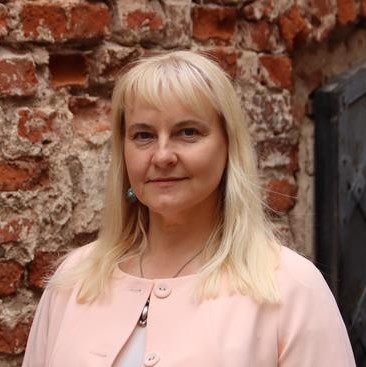
Dr. Dovilė Vengalienė is an Associate Professor at Vilnius University, Kaunas Faculty, where she serves as the Head of the BA study program Language and AI Management. Her research and teaching span the interdisciplinary fields of linguistics, cognitive science, and artificial intelligence, with a particular focus on the intersection of language technologies and communication strategies in digital environments.

Artificial intelligence (AI) has entered education at unprecedented speed, reshaping how teachers teach, how students learn, and how schools organize themselves. Recent surveys show that over 80% of students, both in high schools and universities, already use AI tools in their academic work (HEPI, 2025; Campus Technology, 2024). This reality presents educators with a stark dilemma: should AI be banned from classrooms as a threat to academic integrity, or should it be embraced as a tool to enhance teaching and learning? This presentation invites participants to review up-to-date statistics, examine recent international case studies, and consider emerging tendencies in AI use in education. Drawing on the experience of educators worldwide—from the United States and the United Kingdom to Lithuania and Estonia—it will outline possible answers to these pressing questions and suggest pathways for integrating AI responsibly, ethically, and effectively into the teaching and learning process.

Mantas VIČIUS

Mantas Vičius is a Board member at EdTech, Lithuania, and a co-founder and
CEO at BBright, an educational technology startup based in Lithuania that
created the AIpowered learning platform “Elicėjus” to help students strengthen
their math skills. The idea for BBright originated from his own challenges with
mathematics during school, and the platform today serves thousands of
students across Lithuania. Under his leadership, BBright was selected for the
Google.orgbacked Grow AI accelerator. Currently, Mantas leads a mission-
driven team of ten at BBright and actively contributes to Lithuania’s
educational transformation.

When we think of AI in education, we often picture tools: faster text generation, automated grading, ready-made exercises. But what if AI is not just a tool, but a force that reshapes how we think about teaching itself? What if it could shift the teacher’s role from information provider to creative guide, and transform students from passive participants into active learners and co-creators of their own learning journey?
In this talk, I will share insights from global education trends and my own experience in edtech and practice. Together, we will explore how AI is not about replacing teachers, but about giving them more freedom – to diversify lessons, to experiment, and to focus on what truly matters: human connection and meaningful learning.


Marie WILLOUGHBY

Marie Willoughby has been an English language teacher since 2000 and a teacher trainer since 2006 and has worked on CELTA, DELTA and bespoke training courses in the UK, Peru and China. She has also been a lecturer in the MA TESOL and the MA Applied Linguistics and ELT at King’s College London. Her current role is Teacher Portal Manager; running International House London’s online teacher development platform and working to support teachers to experiment and develop with confidence. She is fascinated by teacher identity and agency, particularly in the light of emerging technologies.

This plenary will examine where we can use AI to help ourselves and our learners to develop and where potential challenges may occur. To do this, we will explore criteria for using AI with students, explore simple and practical frameworks for starting to explore AI in our classrooms both in terms of our learning and for our learners. We will also consider ethical and environmental challenges that AI brings and how we can offset these issues and help make our students more responsible and sensible users of AI.

What is getting in the way of our learners’ listening development and how can we, as teachers, help them? This workshop will answer these questions, looking at how technology combined with classroom practice can help your learners become more proficient and confident listeners. We will explore barriers to listening, experiment with tech-based tools to overcome these barriers and consider practical applications in our own classrooms.

PRESENTATIONS – 30 min (to be updated)

Is education keeping pace with rapid technological change? No doubt. But how?  This presentation examines how AI can support inclusive teaching by addressing the diverse abilities, needs, and strengths of learners. Participants will gain strategies to engage neurodivergent students (ADHD, dyslexia, autism, and others) while also challenging gifted learners who often feel under-stimulated. Practical tools – ranging from adaptive learning platforms to speech recognition – will be introduced alongside discussion of ethical concerns and privacy. I have been using these tools in my classroom, helping to design differentiated, AI-enhanced materials to scaffold literacy tasks and foster critical thinking and creativity. By the end of the session, teachers will be equipped to harness AI for meaningful, personalized learning while strengthening human connection in the classroom.

As a teacher, I often wonder if we are preparing students for the world THEY live in – or the one WE grew up in. This session will explore the evolution from Education 1.0, characterised by one-way transmission of knowledge from teacher to student, to Education 5.0, which emphasises human–AI collaboration, creativity, and solving real-world problems. Educators will be encouraged to reflect on their current practices and envision the future of learning. We will discuss practical strategies and tools that support this transformation, shifting from traditional content delivery to meaningful, student-centred education that truly meets learners’ needs.

An overreliance on AI has diminished students’ abilities to think critically. Now as employers are emphasizing the necessity of 21st-century skills such as critical thinking, creativity, collaboration, and communication (the 4Cs), teachers need to help students develop these crucial skills. Failure to integrate the 4Cs into courses can have dire consequences for education and employment. Despite the drawbacks, AI can be used to improve these critical skills rather than replace them. This presentation will provide strategies for using AI as a supplemental tool rather than a replacement for the 4Cs. Teachers will identify strategies that help students think critically about their own use of technology. We will also explore developing digital literacy among students to evaluate the adequacy of AI responses.

This talk will offer practical and creative ways that AI tools, particularly ChatGPT, can facilitate English teaching including creating thought-provoking literature lessons and exam speaking tasks. The presenter will share practical examples of using AI to assist teachers to design engaging English literature lessons. The presentation will also show that AI can be a really helpful tool to provide exam practice tasks for students, especially regarding the renewed English exam programme. However, with the benefits of modern technology, there are challenges such as ethical concerns regarding academic honesty and the reliability of AI tools which will be addressed in the discussion.

Differentiation is a pedagogical process where the teacher adapts content, process, product and/or assessment to meet students’ different levels, learning needs and interests. AI offers a way to adapt textbooks and materials to meet the varied language levels of students in any one classroom without the teacher spending hours in preparation. AI can help adapt language input in the way of reading texts and vocab, as well as the tasks and output required of students, thus increasing student motivation and achievement. This presentation will briefly discuss what differentiation is, and what studies say about its effectiveness, then look at ways AI can help implement such an approach in the language classroom.

This presentation shares insights and practical tools from a professional development course “The 4Cs: Creativity, Critical Thinking, Communication and Collaboration in Schools” held in Dublin, Ireland. The mobility was part of a short-term international teacher training initiative funded by the National Education Agency of Lithuania (Nacionalinė švietimo agentūra) under the programme “Tęsk: Ateik, Tobulėk, Prisidėk!”. During the course, we explored interactive strategies to develop 21st-century skills in the classroom. The presentation will highlight specific classroom methods for fostering student creativity, collaboration, and communication, along with reflections on intercultural exchange and professional growth. This experience has had a lasting impact on both teaching practice and motivation to share internationally gained knowledge with school communities.

Over the last decade, English for Specific Purposes (ESP) research has been increasingly intense and strenuous covering a variety of professional contexts and thus contributing to a modern and effective educational process that empowers teachers and engages students. Studies investigating different aspects of ESP, such as designing ESP courses, teaching specialised vocabulary, ESP needs analysis, developing functional communicative competence, assessing ESP learners based on an e-portfolio, result in local and global implications that the presenter focuses on. Ongoing and future research encompass AI issues related to teaching and learning.

The use of Artificial Intelligence in education is growing expediently, with the potential to revolutionize the way we learn, teach, and research. As current educators, researchers, and teacher trainers, it is essential to understand both the affordances and dangers of AI and make informed decisions about how we interact with this technology. How do we harness this power and teach future educators to use AI wisely and ethically? This presentation discusses three important skills educators need to harness AI: checking for hallucinations (false or inaccurate information in generative AI); engineering specific prompts for better results using role, context, and task; and being transparent by giving credit for work created with AI through citations.

WORKSHOPS – 60 min (to be updated)

This session introduces language teachers to the practical applications of AI-powered tools in teaching English (or other target languages). Participants will explore how AI can enhance lesson planning, personalise student learning, support assessment, and boost learner motivation. The focus will be on hands-on examples, tool demonstrations, and ethical considerations. No prior AI expertise is required.

This workshop explores the evolving challenges in ELT – from the impact of AI and shifting methodologies to wider global changes – while reaffirming the lasting importance of human connection and professional community. As we adapt to the modern age, it is essential to work together, share concerns, and build context-sensitive solutions through both regional and international collaboration. The presenter will introduce upcoming SOL courses: the Teachers’ SOL Retreat in Serbia and SOL programmes in Devon for students and teachers. These courses offer not only professional development but also rich cultural experiences. Importantly, SOL also provides courses for those who are curious about AI and wish to explore its role in education.

In this workshop, teachers will explore how AI-powered multimodal learning – combining visual, audiovisual, auditory, and interactive methods – can enhance intermediate students’ language acquisition, critical thinking, and media literacy. Participants will use generative AI tools like ChatGPT and Ideogram to create and evaluate content, detect biases, and engage with AI-mediated media. The session introduces parameters for analysis of AI-generated visuals and illustrations of tasks aligned with Bloom’s taxonomy. ChatGPT will serve as a collaborative chatbot to build strong arguments and provide instant feedback. Participants will gain practical strategies and use AI tools to foster students’ creativity, attention to detail, and higher-order thinking skills in the classroom.

In this workshop, we will explore how ChatGPT and Perplexity can enhance English language teaching by supporting the creation of effective prompts and the exploration of synonyms. Crafting prompts not only develops linguistic skills but also fosters critical thinking and creativity, as learners must reflect on language choices and task goals. Practical examples will illustrate how prompts can guide content generation and how synonym searching promotes precision in language use. The session highlights combining AI support with critical evaluation to empower learners in the classroom.

Artificial Intelligence (AI) is rapidly transforming the educational landscape, offering new opportunities for the design, personalisation and assessment of learning content. In this workshop, we will discuss how to effectively integrate AI tools into the English language education process. I will introduce different platforms and applications that help to automate the creation of tasks, improve students’ writing, speaking and reading skills, and promote independent learning. Practical examples, the benefits and challenges of using AI, ethical considerations and safety issues will be discussed. The workshop is aimed at teachers who want to update their methods and discover new ways to motivate students and make lesson planning more effective with modern technology.

This workshop explores the potential of digital tools in fostering interactivity, inclusivity, and effective assessment in English language teaching. By incorporating interactive resources, gamified activities, and AI-powered content creation, teachers can design dynamic, accessible, and engaging learning experiences. These tools support diverse learning styles through personalization, real-time feedback, and differentiated instruction, ensuring lessons adapt to individual student’s needs. They also provide solutions for accessibility and assessment, reducing teacher workload while enhancing student participation. The session demonstrates practical applications of these technologies and highlights how thoughtfully integrated digital strategies can enrich classroom engagement, promote equity, and strengthen language learning outcomes.

In this workshop, English language educators will experience practical, ready-to-use activities for integrating media literacy into everyday lessons. Participants will engage in interactive tasks that model how students can question media messages, spot bias, and assess credibility. With a focus on collaborative exploration rather than theory, the session demonstrates simple yet powerful tools – such as the CRAAP test – that can be adapted for different age groups. Attendees will leave equipped with fresh ideas to cultivate learners’ critical thinking, digital awareness, and language skills, making media literacy both accessible and engaging in today’s classroom.

Artificial Intelligence is no longer just a novelty; it has become a powerful partner in the language classroom. This interactive session explores how AI can move beyond being a digital assistant to become an educational ally that enriches teaching and empowers students to think critically, create, and collaborate. Participants will discover practical, classroom-tested strategies to integrate AI tools (e.g., Decohere: Live Text to Image, Hume: Emotional Engagement, Suno: Language Practice through Music, ChatGPT with guided prompting for ESL teachers, Sketch: Animate Your Drawings, and NaturalReaders: Listening on the Fly) into lesson planning, speaking and writing support, and formative assessment. By the end of the session, teachers will gain a toolkit of ideas to inspire learners and bring new energy into their classrooms.

This workshop focuses on how Artificial Intelligence (AI) can help language teachers save time by streamlining the lesson management process and automating task creation. Participants will explore AI tools that reduce time spent on routine tasks such as lesson planning, materials preparation, assessment design, and classroom organization. By automating repetitive work, teachers can redirect their energy toward meaningful teaching, student interaction, and creative instruction. The seminar will provide practical demonstrations of time-saving platforms and share strategies for integrating them into everyday practice. Emphasis will be placed on how AI supports, rather than replaces, the teacher’s role – freeing up valuable time while maintaining high teaching quality and learner engagement.

SPONSORS AND PARTNERS